Pay & tax
Mileage Allowance Explained: HMRC 45p Rate for 2026/27
How UK business mileage works — the 45p/25p HMRC approved rates, what counts as a business mile, and how to claim tax relief if your employer pays less.
Updated June 2026 · 7 min read
General information only — not financial, legal or tax advice. Rates and rules change; check GOV.UK or official resources before making decisions.
Key takeaways
- HMRC's approved mileage rate for cars and vans is 45p per mile for the first 10,000 business miles each tax year, then 25p per mile.
- Motorcycles are 24p per mile and bicycles 20p per mile, with no tiered drop.
- If your employer pays less than the approved rate, you can claim tax relief (Mileage Allowance Relief) on the difference.
- Relief reduces your tax bill at your marginal rate — you get back 20%, 40% or 45% of the shortfall, not the whole shortfall.
- Your normal commute to a permanent workplace does not count as business mileage.
What are the HMRC mileage rates for 2026/27?
When you use your own vehicle for work, HMRC sets approved mileage allowance payment (AMAP) rates that can be paid, or claimed, tax-free. These rates are meant to cover all the running costs of the journey — fuel, insurance, servicing and wear and tear — not just petrol or diesel.
The rates depend on the vehicle and, for cars and vans, how many business miles you've already done in the tax year. They have been unchanged for many years.
| Vehicle | First 10,000 miles | Over 10,000 miles |
|---|---|---|
| Car or van | 45p per mile | 25p per mile |
| Motorcycle | 24p per mile | 24p per mile |
| Bicycle | 20p per mile | 20p per mile |
What counts as a business mile?
Business mileage is travel you have to do for your job — for example driving to a client, a temporary workplace, a supplier or between two work sites. You can claim for these journeys in your own car, motorcycle or bicycle.
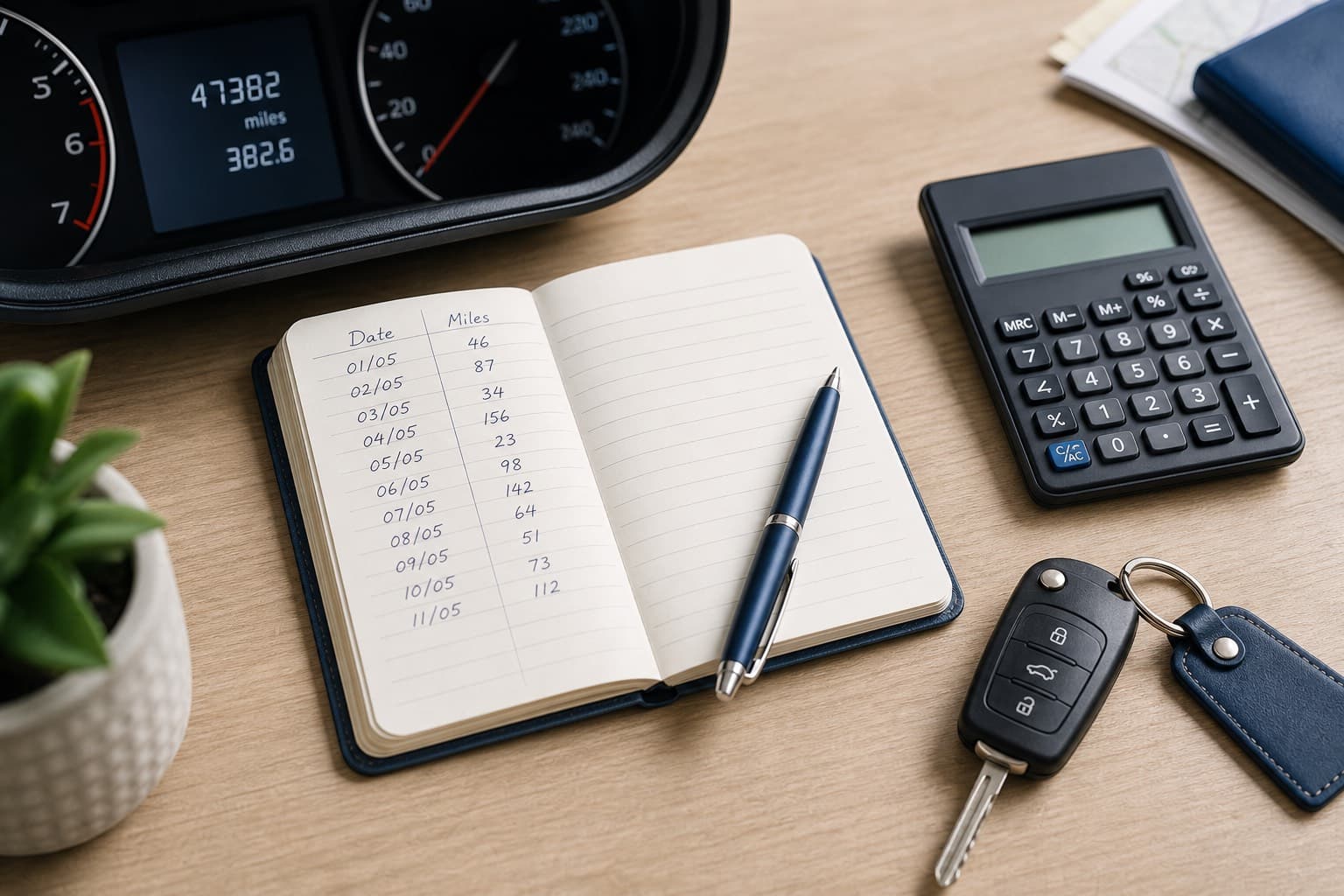
Crucially, your ordinary commute from home to a permanent workplace does not count, even if it's a long drive. Personal trips never count either. Keeping a simple log of dates, destinations and miles makes any claim far easier to support.
- Counts: travelling to a temporary workplace or client site.
- Counts: journeys between different workplaces in the same job.
- Doesn't count: home-to-permanent-workplace commuting.
- Doesn't count: private or personal journeys.
How the 45p and 25p tiers work
For cars and vans, the higher 45p rate applies only to the first 10,000 business miles you do in the tax year. Once you pass 10,000 miles, every extra mile is worth 25p instead.
So 12,000 business miles in a car gives 10,000 × 45p (£4,500) plus 2,000 × 25p (£500), a total approved amount of £5,000. The 10,000-mile counter resets at the start of each tax year on 6 April.
Claiming when your employer pays you mileage
Many employers pay a mileage rate. If they pay the full approved rate (45p), there's nothing more to claim and nothing extra to tax. If they pay less — say 25p or 30p a mile — you can claim tax relief on the shortfall between what they paid and the approved amount.
This is called Mileage Allowance Relief. Employees claim it using form P87 online, or through Self Assessment if they already file a return. Remember it's tax relief: on a £2,000 shortfall, a basic-rate taxpayer gets £400 back (20%), not the full £2,000.
- Employer pays the 45p approved rate: nothing to claim.
- Employer pays less than approved: claim relief on the difference.
- Employer pays more than approved: the excess is taxable income.
Mileage for the self-employed
Sole traders can use the same approved mileage rates as 'simplified expenses' — deducting 45p/25p a mile from business profit instead of working out the actual proportion of fuel, insurance and repairs. For many people this is simpler and gives a similar result.
Once you've used the simplified mileage method for a particular vehicle, you must keep using it for that vehicle until you change it. You can't claim simplified mileage and the actual running costs for the same car in the same year.
Work out your mileage allowance
Use our Mileage Allowance Calculator to work out the approved amount for your business miles and, if you're employed, the tax relief you can claim on any shortfall. If you want to compare the full cost of running your car, try the Car Running Cost Calculator, and the Self-Employed Tax Calculator if mileage is a business expense. These are estimates — always check GOV.UK and keep a record of your journeys.
Frequently asked questions
- What is the HMRC mileage rate for 2026/27?
- For cars and vans it's 45p per mile for the first 10,000 business miles in the tax year, then 25p per mile. Motorcycles are 24p per mile and bicycles 20p per mile. These approved rates cover all running costs, not just fuel.
- Can I claim mileage if my employer already pays me?
- Yes, if they pay less than the 45p/25p approved rate you can claim tax relief on the difference using form P87 or Self Assessment. If they pay more than the approved rate, the extra is treated as taxable income.
- Does my commute count as business mileage?
- No. Travel from home to your permanent workplace is an ordinary commute and doesn't qualify. Business mileage is travel to temporary workplaces, clients or between work sites — and personal journeys never count.
- How much is mileage relief actually worth?
- Mileage Allowance Relief reduces your taxable income, so you get tax back at your marginal rate on the shortfall. A £2,000 shortfall is worth £400 to a basic-rate (20%) taxpayer and £800 to a higher-rate (40%) taxpayer — not the full £2,000.
Try the calculator
Put this into numbers with our free UK calculators.
Need free help? See our useful UK resources including MoneyHelper and StepChange.